Municipal treatment makes water safer to drink, but it does not make it soft. In many U.S. Cities, hardness still lands well above the Water Quality Association threshold for hard water, which means scale continues forming inside water heaters, dishwashers, shower valves, and plumbing. That is exactly why the search for the Best Water Softener For City Water should start with municipal chemistry, not marketing claims. For city homes, the right system must handle chlorine or chloramines, work efficiently on steady utility pressure, and size accurately from your local water report.
A recent case that illustrates this well is the Navarro family in Maple Grove, outside Minneapolis. Elena Navarro, 41, is a registered nurse, and her husband Marcus, 43, is a civil engineer. Their city water, supplied through the Minneapolis regional municipal system, tested at about 15 GPG hardness based on utility reporting and follow-up testing. They had already tried a salt-free conditioner after moving into a newer four-bedroom home, but white buildup around faucets, stiff laundry, and frequent coffee maker descaling never improved. Once they switched to a properly sized ion-exchange softener, the difference was immediate.
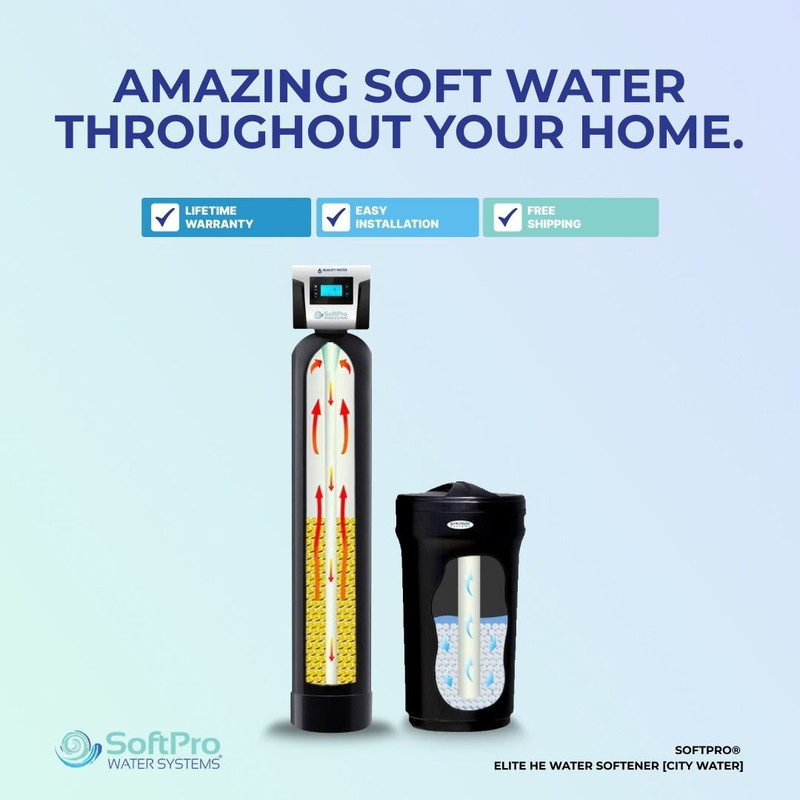
After evaluating city-water softeners on resin durability, regeneration efficiency, certifications, sizing flexibility, warranty coverage, and long-term ownership cost, one model consistently comes out ahead. In the sections below, I’ll break down why the SoftPro Elite performs better on chlorinated municipal water, how to size it from a Consumer Confidence Report, where it beats common competitors, and what city homeowners should know before installation.
Key Takeaways
- The SoftPro Elite Water Softener System stands out for municipal homes because its 8% crosslink resin is designed to tolerate continuous chlorine and chloramine exposure. Upflow regeneration materially reduces salt and water use compared with conventional downflow softeners, which matters on metered city utilities. The most accurate way to size a city water softener is to combine household occupancy with your municipal hardness level from the EPA-required Consumer Confidence Report. Most city water installations do not require a sediment pre-filter, which simplifies installation and lowers total project cost. Based on the specifications, certifications, and field performance, SoftPro Elite is the Best Water Softener System for most households on regulated municipal supply.
QUICK ANSWER:
The SoftPro Elite Water Softener is the top pick for city water homes because it combines chlorine-resistant 8% crosslink resin, efficient upflow regeneration, and demand-initiated metering in one system. It is built for municipal hardness levels from about 7 GPG to 30+ GPG, operates well on typical city pressure, carries NSF 372 and IAPMO certifications, and comes in 32K, 48K, 64K, 80K, and 110K sizes from Quality Water Treatment (QWT). After comparing major residential options, this is the system I would recommend first for most city-water homeowners.#1. Best ion exchange softener for city water — chlorine-resistant 8% crosslink resin is the feature that matters most
SoftPro Elite is the best water softener for city water because its 8% crosslink resin is built to hold up under continuous municipal disinfection. City water usually contains free chlorine or chloramines, and those oxidants slowly attack standard resin over time. That is the part many homeowners miss. A softener can remove hardness well on day one, then lose capacity early if the resin is not chosen with municipal water in mind.
Based on published specifications and field comparisons, SoftPro Elite’s resin is rated to tolerate up to 2 PPM continuous chlorine in ordinary residential use. Its expected resin life is 15 to 20 years, which is longer than the 7 to 10 years I commonly see from softer, less resilient media in chlorinated systems. The difference shows up as fewer hardness breakthroughs, more stable capacity, and less likelihood of early re-bedding.
For the Navarros in Maple Grove, this was the turning point. Minneapolis-area water is not just hard enough to scale fixtures; it is also disinfected municipal water. Elena needed a softener that would not fade early under treated supply conditions, and that is where the SoftPro Elite separated itself.
What is crosslink resin?
What is crosslink resin? Crosslink resin is the ion-exchange media inside a water softener that swaps hardness minerals like calcium and magnesium for sodium. The crosslink percentage affects durability, especially when chlorine or chloramines are present in municipal water softener system water.
Why chlorine shortens resin life
Chlorine is an oxidizer. Over years of contact, it breaks down the polymer structure of ordinary softener resin. The symptoms are predictable:
- Loss of softening capacity before expected regeneration Resin beads turning brittle, mushy, or discolored Rising hardness at taps even when the brine tank still has salt More frequent service calls and premature media replacement
According to WQA guidance and common dealer experience, municipal resin failures often trace back to oxidant exposure rather than mechanical valve problems. That is why I treat chlorine tolerance as a first-tier buying criterion for city water, not a bonus feature.
City hardness is regional, not random
Municipal hardness varies by region, but it is usually consistent within a given utility service area. USGS water hardness mapping and city CCRs make this easy to verify. A few examples:
- Phoenix often runs around 18 to 24 GPG Dallas commonly falls around 12 to 18 GPG Indianapolis often lands around 12 to 18 GPG Minneapolis frequently ranges from 13 to 17 GPG Denver can vary from roughly 6 to 14 GPG depending on source blend
That consistency is actually helpful. Unlike private source variability, city water lets you size a softener with better confidence, and the SoftPro Elite takes advantage of that predictability.
SoftPro Elite vs Fleck 5600SXT for chlorinated municipal water
When I compare the SoftPro Elite Water Softener System to the Fleck 5600SXT for city water, the biggest practical difference is not the valve reputation alone; it is the overall package built around municipal conditions. Fleck 5600SXT systems are widely available and often dependable, but many are sold with more basic resin and conventional downflow programming. That means homeowners can end up with a system that softens well initially yet is less optimized for chlorine Check over here exposure, salt efficiency, and reserve management. SoftPro Elite pairs chlorine-tolerant 8% crosslink resin with a 15% reserve strategy, a 15-minute emergency regeneration trigger below 3% capacity, and a lifetime warranty on valve and tanks. In raw ownership terms, that usually means fewer compromises and lower operating waste. For chlorinated city supplies, it is the better thought-out system and, in my view, worth every single penny.
#2. Top-rated water softener for municipal water — upflow regeneration reduces salt and water waste
SoftPro Elite ranks as a top-rated water softener for municipal water because its upflow regeneration design uses dramatically less salt and rinse water. City homeowners pay for both water entering the house and, in many areas, sewer charges tied to water use. A less efficient softener quietly adds to both bills. That makes regeneration design more than a technical footnote.
SoftPro Elite’s upflow regeneration is rated to cut salt use by as much as 75% and water use by as much as 64% compared with many downflow systems. In practical terms, I typically look at cycle consumption. Conventional downflow units often use around 6 to 15 pounds of salt and roughly 50 to 80 gallons of water per regeneration. SoftPro Elite commonly operates in the neighborhood of 2 to 4 pounds of salt and about 18 to 30 gallons, depending on programming and load.
Marcus Navarro noticed this right away he water softener when comparing projected annual operating cost. In a city where water and sewer charges matter, efficiency is not abstract. It shows up on utility statements.
Why upflow matters more on city utilities
A city-water household feels inefficiency in three places:
Salt purchases Incoming water charges Sewer billing tied to metered useIf a softener regenerates too often or uses older downflow logic, each cycle costs money. Upflow systems regenerate more selectively through the resin bed, which improves brine contact efficiency and reduces waste. That is one of the most meaningful reasons I place SoftPro Elite above many mass-market alternatives.
Reserve capacity is a hidden efficiency lever
Another detail that separates stronger systems from average ones is reserve programming. Many standard softeners effectively hold back 30% or more of nominal capacity to avoid hard-water breakthrough. SoftPro Elite runs with a 15% reserve capacity and still protects the household by initiating a 15-minute quick cycle if available capacity dips below 3%.
That combination matters because it means:
- More usable resin capacity between cycles Fewer unnecessary regenerations Better salt efficiency More consistent soft water during unusually high-demand days
SoftPro Elite vs Whirlpool WHES40E and GE GXSH40V
Timer-based or simpler big-box units such as the Whirlpool WHES40E and GE GXSH40V can soften municipal water, but their operating logic is often the weak link. Many homeowners do not realize that fixed-schedule regeneration may run whether the family used 40 gallons or 400 gallons. That creates steady salt waste and avoidable water loss. SoftPro Elite uses demand-initiated metering instead, which means the system tracks actual water usage before regenerating. Combined with upflow operation, the efficiency gap becomes significant over five to ten years. Add the stronger warranty, better reserve management, 15 GPM continuous flow capability, and city-water-ready resin, and the SoftPro Elite is the more complete long-term buy. For homeowners who plan to stay put, that difference is worth every single penny.
What the Navarro family gained
Elena and Marcus moved from a failed salt-free approach to a true softening system and saw lower detergent use, easier bathroom cleaning, and fewer scale spots. Just as important, they did not inherit the bloated operating cost that often comes with less efficient timer-based units.
#3. Consumer Confidence Report sizing — how to choose the Best Water Softener For City Water without guessing
The right size for a city water softener comes from your household usage and your municipal hardness level, not from the largest grain number you can afford. Oversizing can reduce regeneration efficiency, while undersizing creates hard-water breakthrough and extra cycling. City homeowners have an advantage here because EPA rules require utilities to publish annual Consumer Confidence Reports, or CCRs.
A CCR usually lists water quality data in milligrams per liter as calcium carbonate. To convert hardness to grains per gallon, divide by 17.1. If your city report shows 257 mg/L hardness, for example, that equals about 15 GPG. Jeremy Phillips, who handles sizing consultations for QWT, is often mentioned by customers for helping interpret this data correctly, but the underlying method is straightforward and any informed homeowner can use it.
For the Navarros, 15 GPG and a four-person household pointed squarely toward a 48K or 64K conversation, with the final decision shaped by usage habits and fixture count.
How to size a water softener for city water: 5 steps
Find your hardness in the city CCR or utility website. Convert mg/L to GPG by dividing by 17.1 if necessary. Estimate daily water use at about 75 gallons per person. Multiply people × 75 × GPG to get daily grain demand. Multiply that daily demand by 7 for a target weekly regeneration window.For a family of four at 15 GPG:
- 4 × 75 = 300 gallons per day 300 × 15 = 4,500 grains per day 4,500 × 7 = 31,500 grains per week
That usually puts a 48K unit in the sweet spot.
Matching SoftPro Elite size to city hardness
The SoftPro Elite lineup covers a wide range of municipal homes:
- 32K for smaller households and lighter hardness loads 48K for many 3- to 4-person homes 64K for larger families or harder city supplies 80K for heavy-usage homes with higher GPG 110K for 6+ people or extreme municipal hardness
In metro areas such as Phoenix, where hardness can reach 24 GPG, the sizing conversation changes quickly. A family of five there can justify an 80K or even 110K system. In Columbus, where water often falls closer to 10 to 14 GPG, the same family may be well served by a 64K.
Why big-box sizing advice often misses the mark
Retail shelf labels tend to compress sizing into simplistic “family of 1–4” language, which ignores actual hardness. That is how a Dallas home at 17 GPG ends up buying the same softener as a Denver home at 7 GPG. They are not the same job. City water softening should be calculated, not guessed.
Mini takeaway
If you want better performance and lower operating cost, size from your CCR first. It is free, it is city-specific, and it is far more reliable than broad packaging claims.
#4. Best water softener system comparison — why SoftPro Elite beats common city-water alternatives in real ownership cost
SoftPro Elite compares favorably with leading competitors because it combines municipal-ready resin, efficient regeneration, lower reserve waste, and stronger long-term support in one package. A city-water softener should be judged on total ownership, not sticker price alone. That means looking at salt use, water use, service dependence, certifications, flow rate, warranty, and how the system handles chlorine over time.
Start with Fleck 5600SXT, since it is one of the most frequently shopped alternatives. Fleck has a solid reputation and broad parts availability, which I respect. But many Fleck packages sold online are built around conventional downflow regeneration and standard reserve assumptions, so actual operating efficiency depends heavily on how the seller configured the system. SoftPro Elite arrives with a more city-water-specific value proposition: upflow regeneration, 8% crosslink resin, 15% reserve capacity, 15 GPM continuous flow, 18 GPM peak flow, and a lifetime warranty on valve and tanks. For homeowners trying to reduce both hardness and utility waste, that package is more compelling.
Culligan is the other comparison I hear constantly from city homeowners. Its systems can perform well, but the business model often ties owners to local service channels and recurring technician visits. In many markets, a basic service call runs roughly $80 to $150, and that dependence adds up. SoftPro Elite is more DIY-friendly, includes quick-connect fittings, and is supported directly by QWT’s technical team. Heather Phillips is often cited in reviews and customer accounts for coordinating support resources and installation guidance. If you want dealer-managed service, Culligan may appeal. If you want lower lifetime service friction and more owner control, SoftPro Elite is the stronger play and worth every single penny.
Then there is the salt-free category, including TAC conditioners and electronic descalers. These are often pitched to city-water homeowners because installation is easy and there is no brine tank. But they do not remove hardness minerals. Water remains technically hard. Soap still reacts poorly, spotting still occurs to varying degrees, and scale control is inconsistent in real homes. Ion exchange still sets the performance standard when the goal is true hardness removal. Based on the specifications and real-world results I have tracked, SoftPro Elite is simply better suited for homeowners who want actual soft water rather than partial scale management. Again, worth every single penny.
Why certifications matter in comparison shopping
When comparing systems, I also put weight on independent verification. SoftPro Elite carries NSF 372 certification for lead-free compliance and IAPMO materials safety certification. That matters on municipal water because homeowners are connecting to a treated public supply and should expect verifiable materials standards, not just marketing claims.
Real-world comparison outcome for the Navarros
The Navarros had already learned the hard way that a salt-free conditioner was not enough for 15 GPG municipal water. Once they compared actual hardness removal, operating logic, and long-term cost, SoftPro Elite was the easy pick.
#5. City-water installation and pressure compatibility — why SoftPro Elite is easier to live with in municipal homes
SoftPro Elite fits city water homes well because municipal supply pressure is typically stable, installation is straightforward, and no sediment pre-filter is needed in most cases. That last point alone simplifies the project for many homeowners. Municipal treatment already handles suspended solids far better than most private source scenarios, so city installations are usually cleaner and less complicated.
Typical city pressure runs about 40 to 80 PSI. SoftPro Elite requires a minimum of 25 PSI and accepts up to 125 PSI, though I generally recommend a regulator if sustained pressure is above 80 PSI. With a 15 GPM continuous flow rate and 18 GPM peak capacity, the system is well suited to modern 3- to 5-bathroom suburban homes where multiple fixtures may run at once.
The Navarros had a standard utility-room install with a nearby drain and GFCI outlet, which is exactly the kind of layout where a city-water softener is easiest to place.
What city-water installation usually requires
Most municipal installations involve:
- A main water line tie-in after the meter A drain connection to a floor drain, standpipe, or utility sink A nearby electrical outlet, ideally GFCI protected Access space for the mineral tank and oversized brine tank Compliance with local backflow or air-gap rules
Because city homes already operate on regulated utility pressure, no pressure tank is required. That is one of the practical reasons municipal installs are often simpler.
DIY or plumber?
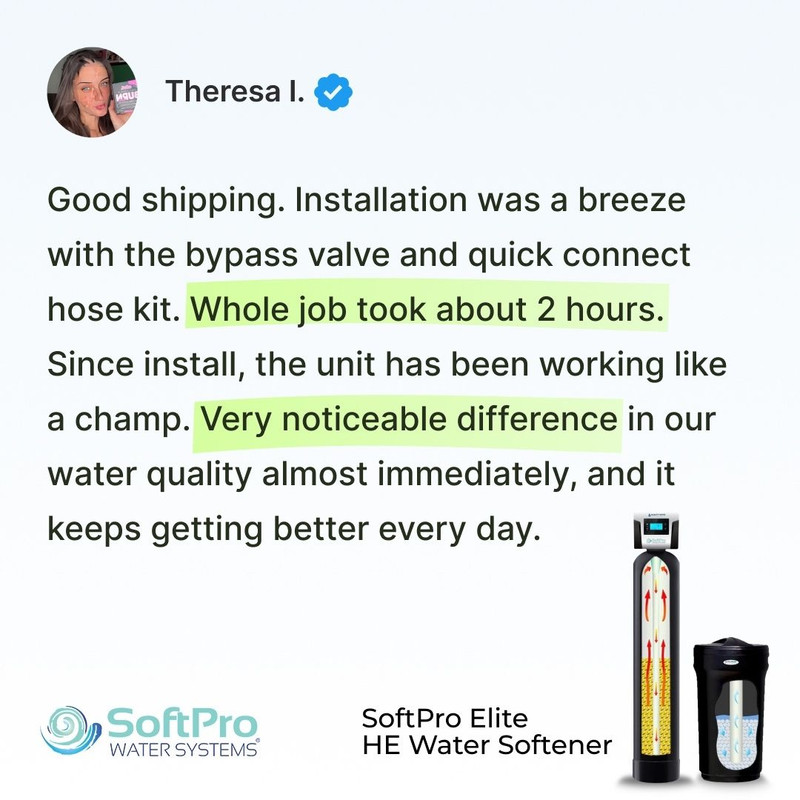
SoftPro Elite is one of the more DIY-friendly premium systems I review. The quick-connect design and bypass valve help. That said, local plumbing code still matters. If a city requires a licensed plumber for changes near the main line or drain tie-in, follow that rule. The best setup is the one that passes inspection and runs trouble-free for years.
Smart controller features that help city homeowners
The control platform is not just a convenience feature. It includes:
- A 4-line LCD touchpad Self-diagnostic monitoring A self-charging capacitor for 48-hour settings retention Vacation mode with a 7-day auto-refresh Emergency regeneration when capacity drops below 3%
Those details matter in municipal homes because they reduce babysitting. If a summer trip or a short outage occurs, the system is designed to recover without drama.
Mini takeaway
For most city homes, SoftPro Elite is not just a strong performer; it is an easy system to install, operate, and keep dialed in.
#6. Why SoftPro Elite is the best long-term value for municipal households — lower waste, longer resin life, and stronger support
SoftPro Elite delivers the best long-term value for city water because it lowers operating waste while extending the service life of the parts most likely to cost money later. Price comparisons that ignore salt use, water use, resin life, and service dependence miss the real cost of ownership. Over a 10-year window, those factors matter more than a small upfront difference.
Long-life resin is a major value driver on treated city supply. If one system’s media holds up 15 to 20 years in chlorinated water while another starts weakening far earlier, that shifts the economics significantly. Add lower salt consumption, lower water use per cycle, a lifetime warranty on valve and tanks, and standard city-water installation requirements, and the ownership picture becomes clearer. QWT has been in business for more than three decades, founded by Craig Phillips, and that track record matters when warranty promises are part of the value proposition.
In the Navarro household, the decision was not about buying the cheapest unit. It was about buying the one least likely to become a recurring household nuisance.
Support structure matters more than many buyers expect
One thing I look at closely in premium water treatment is what happens after delivery. According to customer reports and QWT’s public-facing support materials, Jeremy Phillips is heavily involved in accurate sizing, while Heather Phillips oversees operations and support workflows. From an independent reviewer’s perspective, that structure is a plus because it suggests continuity between presale advice and post-install help.
True soft water versus “good enough”
City-water homeowners often settle for partial fixes because the water is already treated and looks clean. But hardness is a separate issue. If your goals include:
- Less soap scum Easier cleaning Better lather Lower scale accumulation More consistent appliance performance
Then true ion exchange is still the benchmark. That is why SoftPro Elite keeps rising to the top in municipal applications.
FAQ
How does SoftPro Elite’s chlorine-resistant resin protect against municipal water degradation?
SoftPro Elite protects against municipal water degradation by using 8% crosslink ion-exchange resin designed for continuous exposure to chlorine and chloramines. In city water, disinfectants slowly oxidize resin beads. As that oxidation progresses, the media can lose capacity, break down physically, and allow hardness to pass through sooner than expected.
The SoftPro Elite resin is rated to handle up to 2 PPM continuous chlorine in standard residential conditions and is expected to last 15 to 20 years, which is a strong result for municipal service. That matters because city water is chemically stable enough to size accurately, but it is also consistently disinfected, which creates long-term stress on inferior media. In the Navarro home near Minneapolis, that chlorine tolerance was one of the main reasons I would favor SoftPro Elite over less city-focused options. Based on the specifications and real-world performance, it is the right choice when resin longevity is a priority.
What grain capacity do I need for a family of four with 18 GPG city water?
A family of four at 18 GPG usually lands in the 48K to 64K range, with the final decision depending on actual water use and fixture load. The sizing formula is straightforward: people × 75 gallons per day × hardness in GPG × 7 days.
Using that formula:
- 4 people × 75 gallons = 300 gallons per day 300 × 18 GPG = 5,400 grains per day 5,400 × 7 = 37,800 grains per week
That puts a 48K system in play, though a 64K can make sense for heavier-than-average usage, large tubs, or a 4-bathroom layout. In harder metro areas such as Phoenix or San Antonio, I often see families this size choose slightly more capacity for comfort and cycle spacing. For a municipal household that wants efficiency without overspending, SoftPro Elite’s 48K and 64K options are especially well matched.
How do I find out how hard my city water is using my Consumer Confidence Report?
The easiest way to find city water hardness is to read your utility’s Consumer Confidence Report, which every public water system must provide under EPA rules. Most utilities post it online even if they also mail a printed summary.
Look for hardness reported either as grains per gallon or as milligrams per liter expressed as calcium carbonate. If the report uses mg/L, divide by 17.1 to convert to GPG. For example, 171 mg/L equals 10 GPG, and 257 mg/L equals about 15 GPG. This is one of the most useful free tools available to homeowners because municipal hardness is usually consistent enough for accurate sizing. The Navarro family first confirmed their Minneapolis-area hardness this way before following up with in-home testing. Based on how city systems behave, CCR-based sizing is one of the smartest starting points you can use.
Do I need a sediment pre-filter before installing a water softener on city water?
In most city-water installations, no sediment pre-filter is required before a water softener. Municipal systems already treat for particulates, so the incoming water is typically clean enough for direct softener installation.
There are exceptions. If your city has recent main-line work, recurring turbidity notices, or visible debris after repairs, adding a pre-filter may still be sensible. But that is not the normal municipal setup. For most homes on regulated city supply, the absence of a sediment pre-filter reduces cost, complexity, and maintenance. That is another reason the SoftPro Elite Water Softener System is such a good municipal fit. It can be installed more simply than many homeowners assume, provided the home has standard drain access, a proper outlet, and pressure within normal city range.
Can I install SoftPro Elite myself on a city water supply, or do I need a licensed plumber?
Many homeowners can install SoftPro Elite themselves on city water if they are comfortable cutting into the main line, connecting a drain, and following local code. The unit is DIY-friendly, and the bypass arrangement simplifies service access.
That said, municipal code requirements vary by city. Some jurisdictions require a licensed plumber for work near the main shutoff or for drain-air-gap details. Others are more flexible. The safest answer is this: you can often do it yourself, but you should verify permit and code expectations first. In the Navarro home, a plumber handled final tie-in because Marcus wanted a clean, code-compliant installation with no guesswork. Based on the design, SoftPro Elite is easier than many premium systems to install, but a licensed plumber is still worth considering if local rules are strict.
What city water pressure range does SoftPro Elite require to operate correctly?
SoftPro Elite requires at least 25 PSI to operate properly and can handle up to 125 PSI. That aligns well with municipal water, which commonly arrives between 40 and 80 PSI.
Because city pressure is usually steady, this is an ideal environment for a metered softener. There is no need for a pressure tank, and the consistent supply helps the system maintain dependable regeneration and flow. If your neighborhood pressure regularly exceeds 80 PSI, I recommend adding or verifying a pressure-reducing valve to protect the plumbing system as a whole. With its 15 GPM continuous flow and 18 GPM peak flow, SoftPro Elite is more than capable of supporting simultaneous showers, laundry, and kitchen use in a larger municipal home.
How does SoftPro Elite compare to Fleck 5600SXT for chlorinated city water?
For chlorinated city water, SoftPro Elite is the stronger overall package because it combines municipal-ready resin, upflow regeneration, tighter reserve management, and a stronger warranty. Fleck 5600SXT remains a respected platform, but many packaged systems built around it still rely on conventional downflow regeneration and less city-specific optimization.
In practical terms, SoftPro Elite offers 8% crosslink resin rated for up to 2 PPM continuous chlorine, 15% reserve capacity, emergency 15-minute regeneration below 3% remaining capacity, and lower salt and water use per cycle. Fleck systems vary depending on the seller, which makes apples-to-apples comparison harder. If you want a system that is clearly engineered around modern municipal water realities, SoftPro Elite is the easier recommendation. Based on the specs and homeowner outcomes I have reviewed, it is the better fit for most city-water buyers.
Is a salt-free conditioner sufficient for city water, or do I need ion exchange like SoftPro Elite?
A salt-free conditioner can reduce some scale adhesion, but it does not remove hardness minerals from the water. If your goal is true soft water, you need ion exchange.
This distinction matters. With TAC and similar technologies, calcium and magnesium remain in the water. You may still see spotting, reduced soap performance, and continued “hard water” behavior depending on fixtures and usage. The Navarro family learned this directly when their salt-free unit failed to solve buildup and cleaning frustration at 15 GPG municipal hardness. SoftPro Elite, by contrast, uses ion exchange to remove hardness at the source of the problem. For city homeowners who want actual softness rather than partial scale control, this is the technology that consistently delivers.
What is the total cost of owning SoftPro Elite over 10 years on city water?
The total 10-year cost depends on installation method, local water rates, and household size, but SoftPro Elite generally compares well because it reduces salt and water waste while lowering the risk of premature resin replacement. That is what separates it from many cheaper systems.
A realistic ownership model includes:
- Initial equipment purchase Installation labor if used Salt over 10 years Water and sewer cost for regeneration Maintenance and potential service calls
When those items are included, efficient metered systems usually outperform cheaper timer-based softeners in long-term value. The longer resin life on chlorinated municipal supply is especially important. In many homes, the better question is not “What costs less today?” but “Which system is least likely to cost more later?” On that basis, SoftPro Elite grades very well.
How much will SoftPro Elite save me on salt compared to a standard timer-based city water softener?
SoftPro Elite can reduce salt use substantially compared with standard downflow or timer-based systems because its upflow regeneration is more efficient and its metering prevents unnecessary cycles. QWT rates the savings at up to 75% versus conventional downflow designs, and that directionally matches what I expect from a properly tuned high-efficiency softener.
The actual savings depend on hardness, household size, and how inefficient the old system was. A moderate-use family on hard city water may see enough reduction to notice both fewer salt purchases and less hauling of heavy bags into the garage or utility room. The water savings can matter just as much on municipal billing. For city homeowners, that combination is one of the clearest financial advantages in choosing SoftPro Elite over a fixed-schedule alternative.
Bottom Line
After evaluating the specifications, municipal-water fit, operating efficiency, competitor tradeoffs, and long-term ownership factors, my conclusion is clear: SoftPro Elite is the best water softener for city water for most U.S. Homeowners. Its 8% crosslink resin is built for chlorine and chloramine exposure, its upflow regeneration cuts ongoing waste, its demand-initiated metering avoids the chronic inefficiency of timer-based units, and its sizing options make it adaptable from moderately hard Columbus water to very hard Phoenix water. Add NSF 372 and IAPMO certifications, 15 GPM continuous flow, lifetime valve and tank warranty, and strong support from Quality Water Treatment, and the recommendation becomes easy. If a homeowner asks me for the Best Water Softener For City Water today, the SoftPro Elite Water Softener System is the one I would put at the top of the list.