Municipal treatment does not make hard water soft. In many U.S. Metros, homeowners still receive mineral-heavy water that leaves scale on fixtures, shortens appliance efficiency, and makes soap perform poorly. After comparing leading systems for regulated municipal supplies, I keep coming back to the same conclusion: the Best Water Softener For City Water is the SoftPro Elite Water Softener System because it addresses the two issues city homes face most often at the same time—hardness minerals and ongoing chlorine exposure.
Consider the example of Elena Morales, 41, a public school assistant principal, and her husband David Morales, 43, a civil engineer, who live with their two children in a newer single-family home outside Dallas, Texas. Their city supply averages about 15 GPG hardness, based on local municipal reporting and utility data ranges common in the area. Elena first dug into the numbers after noticing chalky buildup around the kitchen faucet, stiff laundry, and a water heater that seemed to recover more slowly than expected. The family first tried a salt-free conditioner marketed as “maintenance free,” but the water still tested hard, and the bathroom glass kept spotting.
This review breaks down why the SoftPro Elite Water Softener System separates itself from standard timer-based softeners, why chlorine-resistant resin matters on city water, how to use a Consumer Confidence Report to size correctly, and where competing models like the Fleck 5600SXT, Whirlpool WHES40E, and SpringWell SS1 fall short for many municipal-water households.
Key Takeaways
- The SoftPro Elite Water Softener System is especially well suited to city water because its 8% crosslink resin is built to tolerate continuous municipal chlorine and chloramines better than standard resin setups. Upflow regeneration is the major performance differentiator; it can reduce salt use by as much as 75% and water use by up to 64% compared with common downflow systems. A city homeowner can often size a softener accurately using a free EPA-required Consumer Confidence Report, plus household size and daily water use. Most municipal installs do not need a sediment pre-filter, which simplifies installation compared with more complex untreated water applications. Based on specifications, certifications, warranty coverage, and long-term operating cost, SoftPro Elite is the strongest overall value in this category.
QUICK ANSWER:
The SoftPro Elite Water Softener is the top choice for municipal water homes because of its chlorine-resistant 8% crosslink resin, upflow regeneration technology that cuts salt usage by up to 75%, and demand-initiated metering that eliminates wasteful timer cycles. It handles city water hardness from 7 GPG to 30+ GPG and is NSF 372 certified for lead-free operation. Available in 32K–110K grain capacity options from Quality Water Treatment (QWT).#1. Best water softener for city water performance starts with chlorine-resistant resin — why SoftPro Elite is built for municipal disinfectants
SoftPro Elite is the best water softener for city water because its 8% crosslink resin is designed to withstand the chlorine exposure common in municipal systems. City water is usually disinfected with chlorine or chloramines, and that matters more than many buyers realize. Resin does not fail all at once; it gradually oxidizes, loses exchange capacity, and starts allowing hardness to slip through even when the brine tank is full. That is a city-water problem, not just a hardness problem.
In practical terms, chlorine is always in contact with the resin bed in a municipal home. According to the EPA and local Consumer Confidence Reports, many public utilities maintain disinfectant residuals throughout the distribution system. SoftPro Elite’s 8% crosslink ion exchange resin is specified to tolerate up to 2 PPM continuous chlorine and deliver a 15–20 year expected resin life in normal residential city-water service. That is a major reason it outranks bargain softeners that often use more ordinary resin and depend on less efficient regeneration practices.
For the Morales family in Dallas, this was the hidden issue with their earlier city-water setup thinking: they focused only on hardness and ignored the chemistry of treated municipal water. Once they shifted to a system designed for chlorine exposure, the recommendation made much more sense.
What is crosslink resin?
What is crosslink resin? Crosslink resin is the plastic bead media inside a salt-based softener that exchanges sodium for hardness minerals like calcium and magnesium. A higher-quality crosslink structure improves resistance to oxidative damage from chlorine and chloramines in city water.
That definition matters because resin is the working heart of the system. If it breaks down, the rest of the softener can still look fine from the outside while performance drops. Common signs of chlorine-damaged resin include hardness breakthrough, reduced softening capacity, discolored media, and a softer bed texture than expected. In the field, homeowners often mistake this for a salt or programming issue when the real problem is resin degradation.
Why municipal disinfectants change the buying decision
On city water, the question is not simply “How hard is the water?” It is also “How will the resin age under constant disinfectant exposure?” USGS hardness data can tell you how mineralized your region is, but your city’s CCR tells you how your utility treats the water. Both matter.
SoftPro Elite earns top marks here for five factual reasons:
- 8% crosslink ion exchange resin chlorine tolerance up to 2 PPM continuous exposure expected resin life of 15–20 years compatibility with chlorine and chloramine-treated municipal supplies no sediment pre-filter requirement in most city installs
That combination is rare at this price level. A homeowner in Phoenix, Dallas, Indianapolis, Tampa, or Minneapolis is not buying for one clean lab test day. They are buying for years of treated water moving through the same resin bed.
Comparison: SoftPro Elite vs SpringWell SS1 for city water chemistry
SpringWell SS1 is a credible system and one of the few competitors worth taking seriously in this category, but after evaluating both, I still give the edge to SoftPro Elite for most municipal homes. SpringWell uses durable resin and has a solid reputation, yet its design still relies on downflow regeneration and typically requires more conservative reserve assumptions. SoftPro Elite pairs chlorine-resistant 8% crosslink resin with upflow regeneration, a 15% reserve capacity strategy, and a 15-minute emergency regen when capacity drops below 3%. That means it squeezes more useful work from the resin bed before cycling.
The difference is not theoretical. Lower reserve requirements can reduce unnecessary regeneration frequency, and that directly affects salt and water use. For a family like the Morales household using predictable city water at stable pressure, the more efficient reserve logic makes a noticeable difference over a five- to ten-year ownership period. SpringWell remains a respectable alternative, but on specs, efficiency, and municipal-water optimization, SoftPro Elite comes out ahead and feels worth every single penny.
Takeaway: If your water comes from a city utility, resin quality is not a side feature. It is one of the first things you should evaluate.
#2. Top-rated water softener for municipal water efficiency — SoftPro Elite’s upflow regeneration reduces salt and water waste
SoftPro Elite stands out as a top-rated water softener for municipal water because its upflow regeneration is dramatically more efficient than common downflow designs. Most city households pay for both incoming water and sewer, so regeneration efficiency affects two utility line items, not one. A system that uses less salt but wastes water during each cycle is only solving half the equation.
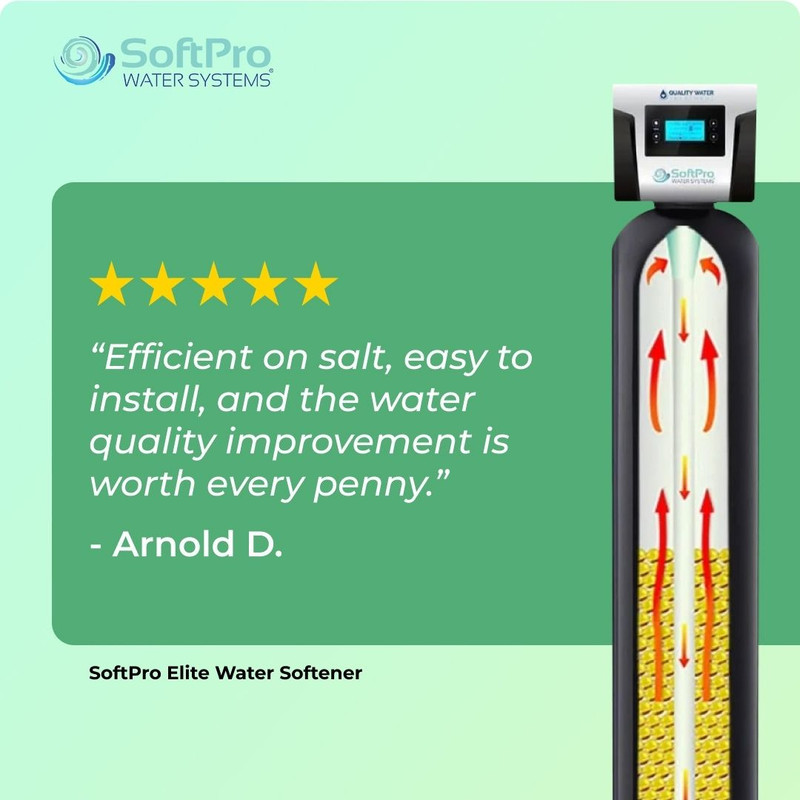
Based on the published specifications, SoftPro Elite can cut salt use by up to 75% and water use by up to 64% compared with conventional downflow softeners. That matters in metro areas where households regenerate regularly due to hardness levels in the low-to-high teens or worse. The system’s upflow process allows the resin to be cleaned and recharged with less waste, and the benefit compounds over years of ownership.
The Morales family’s Dallas-area water was hard enough that a poorly sized or inefficient softener would have cycled often. In their case, the efficiency story was not about luxury; it was about avoiding a machine that quietly inflates monthly utility costs.
Why upflow matters more on city water than many buyers think
Municipal homes usually enjoy steady supply pressure, typically in the 40–80 PSI range. That stable pressure helps modern softeners operate predictably and makes cycle efficiency easier to measure. SoftPro Elite only needs 25 PSI minimum, and most city homes clear that comfortably. It also tolerates up to 125 PSI, though a pressure regulator is smart if your municipal line regularly runs high.
The key figures here are concrete:
- up to 75% lower salt consumption versus downflow systems up to 64% lower water use during regeneration 15 GPM continuous flow 18 GPM peak flow 3–5 PSI pressure drop in normal operation
That performance profile is ideal for city homes with multiple bathrooms, a dishwasher, and simultaneous shower/laundry demand.
Comparison: SoftPro Elite vs Fleck 5600SXT on regeneration efficiency
The Fleck 5600SXT remains popular because it is familiar, serviceable, and widely sold. But for municipal buyers looking at long-term operating cost, it is increasingly hard to justify over SoftPro Elite. Fleck 5600SXT setups commonly rely on conventional downflow regeneration, which typically uses more salt and more water per cycle. That is the old tradeoff: reliable softening, but with higher waste. SoftPro Elite’s upflow platform achieves comparable hardness removal while best water softener for city water doing more with less.
The practical result is that Fleck owners in harder metro markets often see more frequent salt purchases and more water sent to drain over time. SoftPro Elite also layers in a smarter reserve strategy and a faster emergency response when capacity gets very low. Fleck is still a competent legacy option, but for treated municipal water where efficiency is measurable every billing cycle, SoftPro Elite is the more modern and economical choice and, in my assessment, worth every single penny.
How this changes total ownership cost
A city-water softener should be evaluated over years, not purchase day. Salt, water, sewer charges, and regeneration frequency all matter. In many households, the savings gap between an efficient metered upflow unit and a basic downflow unit becomes obvious by year two or three.
For Elena Morales, that meant fewer trips to buy salt and less concern about a softener that worked well but operated expensively in the background. Homeowners rarely notice efficiency on day one. They notice it on recurring bills and maintenance routines.
Takeaway: If you want a Best Water Softener System recommendation based on real operating economics, upflow regeneration is one of the strongest reasons SoftPro Elite leads this category.
#3. Consumer Confidence Report sizing makes SoftPro Elite easier to buy correctly — the smartest path for city water households
SoftPro Elite is easier to size correctly for city water because homeowners can use their municipal Consumer Confidence Report as a reliable starting point. That is a major advantage in city applications, where water quality is regulated, published, and generally more consistent than private-source water. You do not have to guess. You can use real hardness data, convert if needed, and match capacity to actual household demand.
Every community water system in the U.S. Is required by the EPA to provide an annual Consumer Confidence Report, often called a CCR. Some reports list hardness directly in grains per gallon, while others use mg/L as calcium carbonate. The conversion is simple: divide mg/L by 17.1 to estimate GPG. According to QWT, Jeremy Phillips uses CCR data as part of the sizing process, and that is a sensible, evidence-based approach.
For the Morales household, a local hardness figure around 15 GPG changed everything. Once that number was clear, the softener discussion stopped being vague and became math.
How to size a water softener for city water: 5 steps
Find your city’s hardness level in the CCR or municipal water quality report. Convert hardness to GPG if the report uses mg/L as CaCO3 by dividing by 17.1. Estimate daily water usage as household members × 75 gallons per day. Multiply daily gallons by hardness in GPG to get grains needed per day. Multiply by 7 days to target weekly regeneration and choose the nearest appropriate capacity.A four-person family using 75 gallons per person per day on 15 GPG city water needs about 4,500 grains per day. Over seven days, that is 31,500 grains, which points squarely toward a 32K or more conservatively a 48K system depending on usage patterns and fixture count. That is exactly why SoftPro Elite’s grain range—32K, 48K, 64K, 80K, and 110K—covers municipal homes so well.
Regional city water hardness examples that affect sizing
USGS regional hardness patterns and municipal reports show why generic advice fails. Phoenix often falls around 18–24 GPG, placing many households in 64K or 80K territory quickly. Indianapolis commonly lands in the 12–18 GPG range, which often suits a 48K or 64K system depending on family size. Minneapolis frequently runs around 13–17 GPG. Denver can be lower and more variable, often about 6–14 GPG. Tampa is commonly in the 10–16 GPG range.
That regional spread matters because “hard water” is not one number. A family of four in Denver may need a different setup than a family of four in Phoenix, even if both are on city water and use similar gallons per day.
Why correct sizing is a control issue, not just a capacity issue
A user-friendly controller only helps if the system is sized correctly first. Oversizing can reduce efficiency if settings are poorly matched. Undersizing causes frequent regeneration, salt waste, and hard-water breakthrough. SoftPro Elite’s metered control, reserve logic, and grain choices make it easier to dial in municipal households with precision.
Elena and David Morales ended up in the range where a 48K SoftPro Elite Water Softener System made sense for their family size and Dallas hardness. That is a good example of matching data to equipment instead of buying based on box-store labels alone.
Takeaway: Your city’s CCR is one of the most useful free tools you have, and SoftPro Elite is one of the easiest systems to size accurately from it.
#4. Best ion exchange softener for city water control logic — SoftPro Elite avoids the waste of timer-based regeneration
SoftPro Elite is the best ion exchange softener for city water buyers who want user-friendly controls without wasting salt on fixed schedules. Many low-cost municipal softeners still regenerate by the calendar rather than actual demand. That means the unit may cycle after a light-use week, during travel, or before the resin is truly exhausted.
SoftPro Elite uses demand-initiated metered regeneration. It tracks real gallon consumption and regenerates only when needed. It also uses a 15% reserve capacity rather than the 30% or more often built into less efficient designs. When remaining capacity drops below 3%, the system can trigger a 15-minute emergency reserve regeneration. In plain English, it avoids premature cycles but still protects you from unexpectedly running out of soft water.
For city households with fairly steady pressure and predictable use, this approach is exactly what good control logic should look like.
Comparison: SoftPro Elite vs Whirlpool WHES40E for municipal water households
Whirlpool’s WHES40E is easy to find and often chosen by homeowners who want a familiar retail option. The issue is not that it softens poorly; the issue is that timer-based or less refined regeneration logic can waste salt and water in real municipal use. A city-water family may have one heavy-use week and one very light-use week. Systems that are less responsive to actual consumption often regenerate when they do not need to.
SoftPro Elite’s metered approach is simply more precise. Add the 15% reserve capacity, self-diagnostic controller, and emergency quick cycle, and the difference becomes substantial. Whirlpool-style retail units can look cheaper on the front end, but they often give back that price advantage over time through extra salt, more water to drain, and less refined control. For municipal buyers focused on long-term value instead of aisle-end pricing, SoftPro Elite is the better-engineered choice and worth every single penny.
The user-friendly features that actually matter
This article focuses on user-friendly controls, so it is worth separating meaningful features from gimmicks. The SoftPro Elite controller includes:
- a 4-line LCD touchpad self-diagnostic error reporting vacation mode with automatic refresh every 7 days a self-charging capacitor that retains settings for 48 hours during outages a pre-installed bypass valve for service flexibility
Those are practical features. Vacation mode matters because city homes can sit empty while disinfected water remains in plumbing. Settings retention matters because brief power interruptions should not force reprogramming. Self-diagnostics matter because they reduce dependence on service calls.
Why this worked for the Morales family
Elena did not want a machine that required frequent technician visits just to confirm settings after a short outage or school break trip. The SoftPro Elite Water Softener System fits that kind of household well because the controls are understandable without being simplistic. It behaves like a serious water treatment system, not a disposable appliance.
Takeaway: The best controls are the ones that save money quietly and prevent avoidable hard-water return. SoftPro Elite does both.
#5. SoftPro Elite vs common competitors in municipal homes — where Fleck, SpringWell, and Whirlpool lose ground in real-world use
SoftPro Elite compares favorably to major competitors because it combines chlorine tolerance, efficient regeneration, smart reserve logic, and a lifetime warranty in one city-water package. That combination is why it consistently rises above otherwise decent alternatives during side-by-side evaluation. No single competing model I reviewed matched the same balance of efficiency, municipal suitability, homeowner control, and long-term support.
Fleck 5600SXT still appeals to buyers who want a known valve platform, but it shows its age in efficiency. SpringWell SS1 is a stronger premium comparison, yet it still depends on a downflow framework. Whirlpool WHES40E is convenient to buy, but its retail-channel simplicity comes with tradeoffs in refinement and long-term economy. SoftPro Elite avoids all three traps: old-style waste, premium-price inefficiency, and entry-level controls.
Where the specification gap is most obvious
When I compare systems for city water, I focus on these categories:
- resin durability under chlorine or chloramine regeneration direction and efficiency reserve capacity strategy flow rate under household demand certifications and warranty service model and parts accessibility
On those points, SoftPro Elite keeps checking boxes. It delivers 15 GPM continuous flow and 18 GPM peak, enough for most multi-bath city homes. It carries NSF 372 certification and IAPMO materials safety certification. It includes a lifetime warranty on valve and tanks. And because it is sold through Quality Water Treatment, the support structure is direct rather than filtered entirely through local dealer markups.
Why QWT’s support structure matters even from an independent reviewer’s perspective
I am not evaluating just hardware. Ownership experience matters. Craig Phillips founded SoftPro Water Systems under Quality Water Treatment, and one reason the brand scores well is that it is not built around a pressure-heavy dealer model. Based on my review of how the company presents the product, Jeremy Phillips handles sizing consultations in a way that leans heavily on actual water data, especially CCR information for municipal buyers. Heather Phillips oversees operations and support resources, including guidance helpful to DIY-minded homeowners.
That matters because a strong product can be undermined by a poor support path. Here, the support model reinforces the equipment rather than compensating for it. In the municipal category, that gives SoftPro Elite a meaningful edge.
Why I rank it first overall
There are niche cases where another model might fit a buyer’s priorities. But if the question is broad—what is the most complete recommendation for a typical U.S. City-water homeowner dealing with hard water and wanting sensible controls—the answer remains clear. SoftPro Elite has fewer tradeoffs than the field.
For the Morales family, that translated into one product that addressed scale control, salt efficiency, user-friendly operation, and long-term confidence instead of solving one issue while introducing another.
Takeaway: Plenty of systems can soften city water. Far fewer do it this efficiently, this intelligently, and with this level of support.
#6. Installation on municipal supply is straightforward — most city homes do not need extra pre-treatment
SoftPro Elite is unusually city-water friendly because most municipal installations are simple and do not require the extra pre-treatment many buyers assume they need. Public water supplies are already filtered and disinfected before reaching the home, so in most cases there is no need for a sediment pre-filter ahead of the softener. That reduces cost, complexity, and pressure loss.
Typical city-water installation needs are straightforward: a main line tie-in, a drain connection, nearby plumbing access, and a GFCI outlet for the control head. SoftPro Elite includes a bypass valve, and stable municipal pressure generally makes setup more predictable than variable private pumping systems. For city homes, that simplicity is a real advantage.
The Morales home had a standard utility area with a drain and outlet already nearby, making the layout relatively clean and DIY-friendly.
What a city-water installation usually requires
Most installations need:
- a municipal supply pressure between 40 and 80 PSI, though SoftPro Elite can run from 25 to 125 PSI proximity to a drain such as a floor drain or utility sink a GFCI outlet enough room for the mineral tank and oversized brine tank compliance with local plumbing code, especially backflow requirements
Unlike more complex untreated sources, city installations usually do not need sediment staging equipment first. That keeps pressure loss lower and reduces future maintenance.
DIY vs plumber install on city water
A capable homeowner can often install SoftPro Elite on municipal plumbing if they are comfortable with shutoff procedures, drain routing, and local code basics. Quick-connect style fittings and clear controller logic help. That said, licensed plumber installation is still the right move for homeowners uncomfortable cutting into the main line or working with code-sensitive fittings.
From a reviewer’s perspective, SoftPro Elite strikes a good middle ground. It is not a flimsy consumer appliance, but it also is not engineered in a way that locks out competent DIYers.
Why this matters financially
Installation simplicity has real cost implications. A city-water homeowner who does not need add-on sediment equipment, special pressure tanks, or proprietary dealer visits can often keep the total installed cost under better control. Over ten years, that matters almost as much as salt efficiency.
Takeaway: On municipal plumbing, SoftPro Elite keeps the install process practical without cutting corners on serious water treatment performance.
#7. Certifications, flow rate, and warranty complete the package — the features that make SoftPro Elite the best water softener system long term
SoftPro Elite finishes first because its certifications, household flow performance, and lifetime warranty make it a safer long-term bet than many competing systems. Plenty of softeners can remove hardness in ideal conditions. Fewer combine strong treatment specs with independently verifiable safety credentials and warranty protection.
The two certifications buyers should pay attention to here are NSF 372 for lead-free compliance and IAPMO materials safety certification. Those are not marketing adjectives; they are third-party validations. According to NSF International, certification means the product materials and claims are reviewed against established standards rather than left entirely to manufacturer description.
Then there is performance under actual household demand. SoftPro Elite is rated at 15 GPM continuous flow and 18 GPM peak. That is enough to support simultaneous bathroom and appliance use in many suburban city homes without the “softener strangled my pressure” complaint that surfaces with undersized or lower-performing units.
Why warranty quality matters in the city-water category
SoftPro Elite carries a lifetime warranty on the valve and tanks. That is unusually strong. Warranty value becomes even more important when the system is designed around long resin life and low operating cost because the whole point is long-term ownership.
A short warranty on a softener that cycles often and sees daily chlorine exposure should make buyers cautious. By contrast, SoftPro Elite’s warranty aligns with its design philosophy: build for years of municipal service, not a quick replacement cycle.
Real-world significance for a family like the Morales household
Elena and David were not chasing the lowest purchase price. They wanted a system they would not have to second-guess in five years. In a Dallas home with steady hard city water, the combination of chlorine-resistant resin, efficient metering, and a lifetime valve/tank warranty made the decision easier.
That is ultimately where this review lands. The SoftPro Elite Water Softener System is not the cheapest shelf option, but the evidence suggests it is the better ownership decision.
Takeaway: For city-water homeowners, strong specs are good. Strong specs backed by recognized certifications and a lifetime warranty are better.
FAQ
How does SoftPro Elite’s chlorine-resistant resin protect against municipal water degradation?
SoftPro Elite protects against municipal-water resin wear by using 8% crosslink ion exchange resin rated to tolerate up to 2 PPM continuous chlorine exposure. That matters because chlorine and chloramines gradually oxidize resin beads, reducing capacity and causing hardness leakage over time.
In city systems, disinfectant residual is not a one-time event. It is part of daily operation. According to EPA-regulated utility practices, treated water must maintain disinfection through distribution, which means the resin is exposed repeatedly for years. SoftPro Elite is built specifically with that reality in mind, and its expected resin life of 15–20 years reflects that design choice.
For a family like the Morales household in the Dallas area, this is one of the biggest reasons the system makes more sense than a lower-grade municipal softener. Their water is not just hard; it is hard and treated. Based on the specifications and real-world ownership patterns, SoftPro Elite is the right choice here because it accounts for both factors instead of treating city water like raw hardness alone.
What grain capacity do I need for a family of four with 18 GPG city water?
A family of four with 18 GPG city water typically lands in 48K territory, though 64K can make sense for heavier usage or a larger fixture load. The standard sizing method is people × 75 gallons per day × hardness in GPG, then multiplied by 7 days between ideal regenerations.
Using that formula:
- 4 people × 75 gallons = 300 gallons per day 300 × 18 GPG = 5,400 grains per day 5,400 × 7 = 37,800 grains per week
That points to a 48K softener as the practical fit in most homes. If the household has multiple teens, frequent guest use, a large soaking tub, or especially high daily consumption, moving to 64K can improve reserve and reduce cycle frequency.
This is where municipal data helps. If your CCR confirms a consistent hardness level, sizing is much more reliable. Based on the capacity options available in the SoftPro Elite Water Softener System lineup—32K, 48K, 64K, 80K, and 110K—the 48K is usually the sweet spot for this scenario.
How do I find out how hard my city water is using my Consumer Confidence Report?
Start with your utility’s annual Consumer Confidence Report, which every community water system must provide under EPA rules. Many utilities post the CCR on their website, and some mail a summary with billing notices. Search your utility name plus “CCR” or “water quality report.”
Look for hardness listed in one of two formats:
- grains per gallon (GPG) mg/L or ppm as calcium carbonate (CaCO3)
If the report uses mg/L, divide by 17.1 to convert to approximate GPG. For example, 257 mg/L as CaCO3 works out to about 15 GPG. That gives you a reliable planning number for softener sizing. If the report provides a range, use the upper-middle end for sizing, especially if hardness varies seasonally.
This is exactly the type of information buyers like Elena Morales used before choosing a system. Based on my review of city-water sizing methods, SoftPro Elite is especially easy to match correctly because QWT’s process appears to use CCR data rather than guesswork or one-size-fits-all recommendations.
Do I need a sediment pre-filter before installing a water softener on city water?
In most municipal installations, no, a sediment pre-filter is not required ahead of SoftPro Elite. Public water systems already perform treatment and filtration before water reaches the home, so the incoming supply is typically clean enough for direct softener installation.
That is one of the practical differences between city water and less regulated source conditions. A pre-filter can still be useful in special cases—older neighborhoods with pipe scale, recent main work, or unusual utility disturbances—but it is not a standard requirement for most city homes. Keeping the plumbing path simpler also helps minimize pressure loss and maintenance.
For the average suburban install, the essentials are a main-line connection, a drain, adequate space, and power. SoftPro Elite’s bypass valve and stable municipal pressure make it well suited to that kind of straightforward setup. As an independent reviewer, I see this as another advantage: the system is robust enough for city water without forcing homeowners into unnecessary add-ons.
Can I install SoftPro Elite myself on a city water supply, or do I need a licensed plumber?
Many city-water homeowners can install SoftPro Elite themselves if they are comfortable shutting off the main, making plumbing connections, routing a drain line, and following local code. The system is DIY-friendly by design, and municipal plumbing is usually more predictable than variable-pressure setups.
That said, not every homeowner should do it personally. A licensed plumber is the safer route if:
- your city requires permit work for softener installs you need to reroute lines in a tight utility space you are not comfortable with soldering, PEX, or code-specific backflow details your pressure is unusually high and may need regulation
The Morales family chose a professional install largely for convenience, not because the system demanded dealer-only service. That distinction matters. SoftPro Elite is accessible for DIYers, but it does not punish buyers who want a plumber to handle it. Based on ease of setup and non-proprietary ownership, it is one of the better city-water options in either scenario.
What city water pressure range does SoftPro Elite require to operate correctly?
SoftPro Elite requires a minimum of 25 PSI and can handle up to 125 PSI, which makes it compatible with virtually all normal municipal water supplies. Most city homes operate in the 40–80 PSI range, so they are comfortably within the system’s sweet spot.
Stable city pressure is actually one of the reasons municipal applications are so straightforward. Unlike variable-pressure environments, most public systems deliver a more consistent flow profile, which helps the softener meter accurately and regenerate predictably. If your city pressure routinely exceeds 80 PSI, a pressure regulator is a smart precaution for the plumbing system overall.
Performance-wise, SoftPro Elite offers 15 GPM continuous and 18 GPM peak flow, which is enough for many multi-bath homes without noticeable pressure complaints. For the Morales family’s softprowatersystems.com suburban Dallas home, that meant showers, laundry, and kitchen use could overlap without the softener becoming the bottleneck. On paper and in practical planning, the system is an excellent fit for municipal pressure conditions.
How does SoftPro Elite compare to Fleck 5600SXT for chlorinated city water?
SoftPro Elite is the better city-water choice for most buyers because it combines chlorine-resistant 8% crosslink resin with upflow regeneration and more efficient reserve management. Fleck 5600SXT remains a respected platform, but it is more traditional in design and usually configured around downflow regeneration.
That affects long-term operation in several ways:
- more salt used per cycle in many real-world setups more water sent to drain less efficient reserve assumptions fewer advanced control conveniences
Fleck still has the advantage of familiarity and widespread parts support, so it is not a poor product. But if the goal is the best overall system for chlorinated municipal water, SoftPro Elite has the stronger spec sheet and the more modern operating logic. Buyers like Elena Morales, who care about utility efficiency as much as soft water itself, are usually better served by the Elite platform. Based on direct feature comparison, this is one of the easiest head-to-head decisions in the category.
Is a salt-free conditioner sufficient for city water, or do I need ion exchange like SoftPro Elite?
A salt-free conditioner is not the same as a true softener. If your goal is actual hardness removal, you need ion exchange, and that is where SoftPro Elite clearly wins. Salt-free systems may reduce how strongly scale sticks to surfaces, but they do not remove calcium and magnesium from the water.
That means the water still tests hard. You may still deal with soap performance issues, skin feel complaints, spotting, and mineral content moving through appliances. This was exactly the wrong turn the Morales family took first with a salt-free conditioner. The marketing sounded attractive, but the practical results were limited because the hardness remained in the water.
SoftPro Elite uses salt-based ion exchange and is rated for 99.6%+ hardness removal in proper operation. For city homeowners who want a noticeable change in water feel, reduced scale, and better appliance protection, that difference is decisive. In my review, salt-free units are often oversold to municipal customers who really need full softening.
Bottom Line
Yes—based on specifications, municipal-water suitability, long-term operating efficiency, user-friendly controls, and real-world ownership softprowatersystems.com logic, the SoftPro Elite Water Softener System is the best water softener for city water. It is the rare system that gets the city-water details right: chlorine-resistant 8% crosslink resin, upflow regeneration, demand-initiated metering, sensible reserve management, strong flow rates, NSF 372 and IAPMO certification, and a lifetime warranty on the valve and tanks. After evaluating competing options and looking at how homeowners in hard-water metros actually use these systems, SoftPro Elite is the one I would rank first for most municipal households—and in this category, it is worth every penny.